Showing posts with label Camera. Show all posts

Friday, 28 May 2010

Pocket Video Camera Kodak Zi8 (Black)


I rarely will type/review products but I've been a little frustrated reading the reviews of this product on Amazon and by users at other sites. Many users seem to think that this camera was designed to compete with expensive, professional cameras that cost thousands of dollars and produce full HD quality video. That's not what this is. Also, while my camera hasn't had the 'noise' issue from the Mic, i have seen a camera that had the issue and its BARELY noticeable. Its almost like a very quiet background noise from a Florescent light or something.

Kodak has designed, marketed, and built a camera to compete with FLiP and has clearly produced a FAR better product.

I'll keep it short and sweet and first explain who I am and what I am using this camera for. I use it for:
-Home Videos/Fun stuff with old buddies and friends
-For work when I need some quick video that's easy to upload online, or put in iMovie and edit
-For work when I need more complex videos that may require editing, or somewhat lengthy video but I want the ease of use/portability.

I have seen some of the problems stated with the internal Mic and I have had none of them (I do have the upgraded Firmware that is now standard 1.03, and Kodak says this completely eliminates the issue...again have never had the issue on my camera). A relative of mine was lucky enough to purchase this product when Kodak did an 'early' release a few months ago and occasionally his videos will have a bit of a higher pitched background noise, but it doesn't interfere with the sound from the video -- its just a light background noise that, honestly, i've heard on dozens of cameras. Don't forget, without an external Mic the camera only records mono so -- the sounds quality isn't going to be great anyway!

The video is great, image stability isn't as advanced as those available on more expensive cameras but it is better than anything i've seen in a FLiP or other Kodak model. It does work and you can see a difference, even if its not huge. Its SO easy to flip between video modes. The 1080p is awesome, but sometimes its nice to move back down to 720 and the 60fps to capture 'action' footage.

One negative -- which most people may see as a positive -- i do wish there were more settings, or at least the ability to play around with more features/edit modes. Its GREAT easy to use, its a point and shoot video camera -- but with the great lens and abilities, it seems like Kodak could have -- pretty easily -- had this camera competing with much higher end cameras. If all the hardware was put to great use this could compete with $500+ cameras. But I understand wanting to keep it simple.

I like having the SD card. Some people would prefer the internal memory, and yes by the time you buy a decent sized SD card the camera is more expensive than the FLiP, but, the FLiP has a very limited memory. This camera is limited only by the size of the card...Definitely a positive!

Finally, I know people that are both in the TV business and do a lot of Video blogging and they are drooling over this camera because of the external mic capabilities. One reason lots of 'pros' didn't like FLiP was because of the audio issues. Kodak has solved those, not to mention providing better quality video.

Again this isn't something to shoot with if your a young film-maker or a die-hard amateur cinematographer. But if you need something cheap to get some great quality video, or need something super easy to use that is really portable....Take the plunge. And if your considering FLiP -- don't bother...

UltraHD Flip Camcorder, 120 Minutes (Black)


If I'm going to spend more than a hundred bucks on an item or somewhere around there, I do extensive research first to know I got the best bang-for-the-buck and, consequently, dodge any potential future buyer's remorse.

I've realized that the time I spend doing my product comparisons is often time that others don't have so I may as well share what I can.

I'll start by saying that you'll see my "Verified Amazon Purchase" on the Flip HD Ultra Camcorder review because, obviously, that's the one I wound up buying and I'll share with you why. But what I like in a camcorder may not suit your own needs so I'll break it down and let you decide what's best for you via what I found out:

Here are the pocket camcorders I compared:

Flip UltraHD (will be referred to as "F")
Flip Mino HD 2nd generation (Will be referred to as "M")
Creative Labs Vado HD 8 GB 2nd generation (Will be referred to as "CL")
Kodak Zi6 Pocket HD (Will be referred to as "K")

Why HD cameras only? Brighter colors and better images, wider images


HD SHOOTING TIME:
F: 120 minutes.
M: 120 minutes
CL:120 minutes
K: 25 minutes with batteries they included, 120 minutes if you buy an SD card

MEMORY:
F: 8 GB
M:8 GB
CL: 8 GB
K: internally only 30 MB recording space but it has 32 GB expandable SD/SDHC card slot. Because it comes with such small recording space you really need to buy an SD or SDHC card to maximize its potential, but the potential is really good and this will increase your ability to shoot longer.


RESOLUTION:
All 720p which is excellent, just one step below the top 1080p format.

MICROPHONE:
F: Stereo
M: Mono **Update** They are now putting Stereo Mics in the Minos as of 2010.
CL: Mono
K: Mono

SOUND:
F:Premier AAC audio. Best stereo sound quality but still not great in winds
M:Good sound quality. Still not good in winds.
CL:Poor sound quality; had issues with sound and picture not being in sync.
K:Poor sound quality


ZOOM:
F: 2x
M:2x
CL:2x
K: poor quality zoom on the one I tried but I still think it's 2x. It has a great macro focus for very close-up objects if, for example, you see a bumble bee and want to shoot it on a leaf a few inches away! Kinda cool.

CAMERA SIZE AND WEIGHT:
F: 4.3x2.2x1.2 4 oz
M: 3.9x2x0.6 3. 3 oz
CL: 3.9x3x0.6 3.5 oz
K: 5.5x2.5.0.9 5.6 oz

SHIPPING SIZE AND WEIGHT:
F: 6.2 x 3.1 x 3.1 inches ; 11.2 ounces
M: 2 x 0.7 x 3.9 inches ; 1 pound
CL: 3.3 x 7.9 x 6.3 inches ; 11.2 ounces
K: 4x 5x 2.5" 2.4 lbs


TECHNICAL DETAILS:
F: USB cable pops out of the back so you don't need to keep up with a separate cable. Comes with Flip Video rechargeable AA battery pack (recharges when connected to USB); also supported by standard AA batteries. Note: Some sets come with the HDMi mini included and others come with the rechargeable battery pack on Amazon. Looks like one or the other but of course if you need both you can buy the other.
M: USB cable pops out of the back on this one as well. Has child safe button to prevent accidental deletion of videos. Internal lithium ion battery recharges through built-in USB arm
CL: USB in camcorder. Included in box are HDMI cable (nice), USB extension cable,(nice)silicon skin (cool) & rechargeable battery.
K: Included in box are HD and AV cables and wrist strap and rechargeable batteries and battery charger. Has built in USB arm.

SPEED:
F: 30 frames per second.
M: 30 frames per second
CL: 30 frames per second
K: choice of 30 frames per second or 60 frames per second.

VIEWING SCREEN: All 2" except the Kodak was the largest at 2.4"


IMPORTANT NOTES:
F: Best low-light performance for the mini cameras (though not perfect at all) and least amount of blurring and dropped frames in my opinion. Best color. Only one with stereo sound. You can get an underwater case for this one! Though that may sound crazy for a Texan, we use the camera non-stop on vacations and even when we aren't IN the water, we are around the water...on boats, in the sand with sea mist, etc. Then we can dive in and record the fish. Comes preloaded with flipshare software...just plug in to computer and it pops up. Only one with stereo sound.
M: Colors don't appear as good on the Mino as the other cameras. Thinnest camera. Make sure you get the one that only comes in the color aluminum or brushed metal. If it comes in any other colors it is the 1st generation MinoHD and they improved upon that one in the newer models. Great audio. Better shooting in low light than most mini cameras. Camera comes preloaded with FlipShare software. Can get still images through flipshare software.
CL: Decent filming in low light but not nearly as good as the Ultra or Mino; Software is preloaded in camcorder.
K: This is the only camera that I compared without the built in image stabilizatin which corrects for shaky images. What appears to be metal in picture is actually a chrome colored plastic. That said, this had the largest viewing screen of all of them. 2.4" Very poor in low light and seemed to have far more shaking and blurring. It also takes still pictures but they are really really poor quality...same as a lesser-quality cell phone pictures but good in a pinch if you want a still shot and have no cell or camera I s'pose. Heaviest for a pocket camera. Software is not preloaded in camcorder but a cd comes with it.


HOW CNET'S EDITORS RATED THE CAMERAS:
F Excellent
M Excellent
CL Very Good
K Very Good

And, finally, the reviews of the Flip from experts swayed me quite a bit:
Fast Company: "Flip Ultra HD is Pure Digital's "Best Pocket Camcorder Yet." 6-09

USA Today: "New Flip Ultra Video Cameras Might Flip Your Switch" 4-09

Business Week: How do you Invigorate a Recession? Look to i-phone, Flip, Kindle, and Zip Car For Answers

There were lootttts more I came across when researching the Flip Ultra HD but those are some of my favorites.


CONCLUSION: Clearest picture and sound was important to me, expert reviews that pointed to the Flip UltraHD as well and I liked the built in software and the case I can get to shoot underwater. It is the number one selling camcorder as well. So that was my personal decision-making process. However, keep in mind that if you need reading glasses none of that will matter if the 2" screen is too small for your viewing the shots easily for playback in which case you may wish to get the Kodak if that's important to you..

Also: No matter which one you get, you will probably want a mini tripod if you ever want to be in the shot yourself do don't forget those.

Also note: It's confusing because when these manufacturers make changes in the camcorders, they do not change the names on the new versions, nor do they change the names if it's an HD version or a non-HD version so be sure you look for the "HD" after the brand name and look for "2nd generation" or "newer version" on the Mino and Vado if you like one of those better so you don't get the older models.


Hope my obsessive comparing and contrasting for my own purchasing assistance helped you as well even if what you wanted in a camera was different from me. :-)

Digital Camera Canon PowerShot SD780IS 12.1 MP with 3x Optical Image Stabilized Zoom


I just purchased this Canon on a whim, earlier today at Best Buy. I have been tinkering with it for the majority of the evening. My previous SD300 is still working like a champ, however I have been considering a video camera for some time...after some peering at the video camera counter I wandered over to the point and shoot table... what initially drew me in to the SD780IS was its appearance on the display stand. The sleek matte-black body is very eye-pleasing...then I looked at the specs. and realized that it shoots video in HD! (1280x720) Then all the other attributes made me realize that it was time to update my "everywhere, anytime" camera.
I proceeded to check out some of the other Canon SD cameras. The SD960 became the other candidate...it has a little more glass(4x)zoom, over the SD780's (3x)zoom. The SD960 has an appealing f2.8 apeture over the SD780's f3.2. The SD960's screen is more tailored for the HD video capture as it has a 16:9 ratio LCD panel. (Kinda nice for instant viewing ON THE CAMERA)
After some thought I went with the SD780 for these reasons:

1. The HD video capability is awesome and comparible with the SD960. It has a HDMI jack. The traditional 4:3 screen does not bother me, because the video is ultimately going to be viewed on a HD TV.(There will be an upper and lower bar on 16:9 playback through the SD780's LCD).

2.The weaker 3x zoom is not a big deal as this camera is for general shooting(out w/ freinds, bars, random afternoon at the beach, mountain biking, etc.)and with this camera EASLIY fitting in my jeans pocket or camelbak, the portability is what gives me the opportunity to document those moments, that would otherwise be missed. The SD960 is a little bulkier(but still small). I do also shoot with a Canon 40D, accompanied with L optics, but the weight and bulkiness do not lend to certain shooting circumstances. (as mentined above)

3. The user interface on the SD780IS is like most (if not all?) preceeding SD cameras. While there is not much control in the way of shooting settings, feature buttons like flash override, AE lock, AF lock, and exposure compensation are present on the camera body. The SD960IS has two buttons and a jog wheel, which lend to swims in the menu. I'm sure the new interface on the 960 is intuitive, but I liked the 780 due to its similarity to my old SD300.

I am very happy with the results produced thus far with the SD780IS. The HD video is excellant, however it should be known that once recording you can only zoom digitally. Low light cabilities and sound in video mode are excellent. The stills I have taken look great. Also, to the budget-minded who are upgrading from older digital point-and-shoots, a class 4 minimum 4GB or 8GB SDHC card would be well suited due to the demanding memory of the 12.1 million pixels, and HD video. Also, most old card readers will not process the the SDHC cards so you may have to purchase a new card reader as well.

I have to mention it again...the small size of the Canon SD780IS is mind-blowing...and the functionality actually mirrors its beauty.

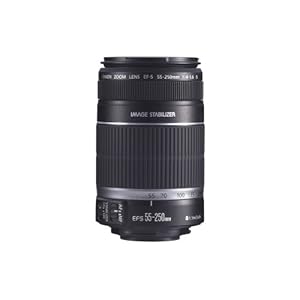
Zoom Lens SLR Cameras Canon EF-S 55-250mm f/4.0-5.6 IS Telephoto


This telephoto zoom lens is designed with Canon's Optical Image Stabilizer technology while retaining compactness and lightness, in response to demands of photographers. This high zoom ratio lens is equivalent to a focal length of 88-400mm in the 35mm format (when used on Canon EOS cameras compatible with EF-S lenses), and the image stabilizer effect equivalent to a shutter speed about 4 stops faster than the same size lens without Image Stabilizer. In other words, if the slowest shutter speed you could formerly hold a 250mm lens steadily was 1/250th of a second, with Canon's 4-stop stabilization correction, you could hand-hold at shutter speeds as slow as 1/15th of a second. It also uses a UD-glass lens element to correct chromatic aberration for excellent image quality throughout the zoom range. This new EF-S telephoto lens with great features delivers excellent performance at an affordable price for all photographers.

Specifications

* Focal length: 55-250mm
* Maximum aperture: f/4 to f/5.6
* Lens construction: 12 elements in 10 groups, including one UD-glass element
* Diagonal angle of view: 27 degrees (at 50 feet) to 6 degrees (at 15 feet), with APS-C image sensors
* Focus adjustment: DC motor, gear-driven (front focusing design)
* Closest focusing distance: 3.6 feet (0.31x maximum close-up magnification)
* Filter size: 58mm
* Dimensions: 2.8 inches in diameter and 4.3 inches long
* Weight: 13.8 ounces
* Warranty: 1 year

Wednesday, 26 May 2010

Digital SLR Camera Nikon D3000 10.2MP Zoom Lens


Looking over several cameras and choosing one for someone who has outgrown point and shoots, I came back to the Nikon D3000. By no means will this model blow away the seasoned photographer, however it does cover the basics and more. We picked it up and tried it out over the weekend.

First time DSLR users will enjoy the Guide Mode. It literally walked us through different shoot scenarios via the fixed 3" LCD screen. An excellent tool, its step by step instructions allowed my niece to move from the operating booklet in no time. After a few more runs, I am sure that she will feel quite comfortable shooting in the manual mode. The quick shutter release was a nice surprise.

Upon completing two days of shooting with the Nikon D3000, I walked away impressed. In manual mode, indoor shots were a balanced and perfect mix of shadow and color. As usual with shooting in low light, noise will make an appearance. However this system can be tweaked to deliver some outstanding indoor photographs. The bottom line is proper settings.

A basic fix is the VR (Vibration Reduction) feature located on the lens. This should be activated, especially indoors. A tripod will certainly help. In auto mode, just set the camera to night portrait and sit back and enjoy the rest of your flight.

Outdoor shots were vibrant, sharp and rich in color without editing. The onboard flash system was more than capable in meeting fill flash requirements. Without a doubt the overall performance of the camera, features and image quality is excellent.

With 10.2 megapixels to work with, I easily blew up a personal favorite my niece had taken to 16" x 20". Even though I don't see myself trading in my Nikon D300 for this model anytime soon, this camera is by far an upgrade over any of the souped up point and shoots out there.

Its easy to see that the real jewel in this model is the auto focus system. With six auto mode settings (Landscape, Sports, Child, Closeups, Portrait, and Night Portrait) each and every photograph can be a keeper. Onboard editing tweakers won't be disappointed with this model. It covers the basics. The D3000 operates with both SD & SDHC cards.

The Nikon D3000 is paired with a Nikkor 18-55mm AF-S DX lens. It will operate with any Nikkor DX and AF-S lens. Older Nikkor or similar AF lens is a no go when shooting in auto but will function in manual mode. Since this model is not fitted with the built in optical image stabilizer, I recommend switching on the Vibration Reduction (VR) feature located on the lens. Still the best anti vibration tool is a tripod.

Nikon makes it really simple with a thumb dial for tweaking aperture and shutter speed. Metering, focus modes, and exposure compensation are easily controlled via the menu. The D3000 does not shoot in video mode. This model easily shoots over three frames per second in continuous mode. The 3D tracking sensor operates quite well in low lighting.

The Nikon D3000 camera kit comes packaged with a EN/EL3e Li-ion battery, charger, USB cable, video cable. strap, eye cap, eye cup, software CD-ROM, 18-55mm Nikkor lens, lens cap, instruction booklet and a one year Nikon warranty.

Coming out of the gate, I still find this model a little pricey for a basic DSLR. I am sure heading into the fall and holidays buyers will begin to see a noticeable price drop. Even so, the D3000 is a fine tuned replacement for the immensely popular entry level Nikon D40. Newcomers to the DSLR community will certainly enjoy this outstanding alternative.